Showing posts with label Recipe. Show all posts

Tuesday, February 15, 2011

What's Cookin'? Tuesday - Brown Rice Pilaf

The CalSERVES Nutrition Program brings you What's Cookin'? Tuesdays! The theme for February is dried fruit.
 
Reasons to Eat Dried Fruits
One serving of most dried fruits provides:
  • A source of dietary fiber (e.g., dates, dried figs, dried plums, raisins).
  • Potassium, which the body needs to maintain muscle contractions and a healthy nervous system (e.g., dried plums, raisins).
  • Iron, an essential mineral for maintaining the delivery of oxygen throughout the body (e.g., dried figs, raisins).
  • A source of calcium, Vitamin A, Vitamin C, B-complex vitamins and magnesium (e.g., dates, dried figs, dried plums, raisins).
Dried Fruit History
  • Athenians, including Plato, referred to themselves as “philosykos,” which translates to “friend of the fig.”
  • After his failed gold mining venture, Frenchman Louis Pellier introduced Californians to dried plums at his Santa Clara Valley nursery in 1856.
  • Raisins are noted in ancient writings as far back as 1490 B.C.E., but it wasn’t until 1876 when Scottish immigrant William Thompson developed a seedless grape variety in the San Joaquin Valley that the raisin industry was launched.
  • Early USDA explorer Bernard Johnson became the “father of the California date industry” when he established a research station near the desert town of Mecca in the late 1880s.
For historical timelines, visit: www.harvestofthemonth.com

Brown Rice Pilaf with Sage, Walnuts and Dried Fruit
Serving Size: 1/8 of recipe
Yield: 8 servings

Ingredients:
as needed canola cooking spray
1 medium onion, chopped
1 medium stalk celery, ends trimmed and chopped
2 cups brown rice, uncooked
2 1/2 cups water
2 cups fat-free vegetable broth, reduced sodium
1/4 cup dark raisins
1/4 cup dried apricots, chopped
4 cup chopped walnuts (optional)
1 teaspoon dried sage
2 Tablespoons fresh sage, chopped
salt, to taste
pepper, to taste


Instructions:
  1. Spray the large skillet with canola cooking spray. Heat skillet over medium heat.
  2. Sauté onion and celery until tender, about 5 minutes. Add brown rice and sauté for 5 minutes.
  3. Add water, broth, raisins, and apricots; heat to boiling. Reduce heat to low, cover and simmer until rice is tender and liquid is absorbed, about 50 minutes.
  4. Stir in walnuts if desired, sage, salt and pepper.
  5. Transfer to serving dish. Garnish with fresh sage and serve immediately.
Cost:
Per Recipe: $ 3.03
Per Serving: $ 0.38

Calories 220, fat 1.5g, sodium 130mg, sugar 3g, protein 5g

Tuesday, February 8, 2011

What's Cookin'? Tuesday - Oat Bran Muffins

The CalSERVES Nutrition Program brings you What's Cookin'? Tuesdays! The theme for February is dried fruit.
Dried Figs
Serving Size: • cup (40g)
Calories 113 Calories from Fat 2
% Daily Value
Total Fat 0g 0%
Saturated Fat 0g 0%
Trans Fat 0g
Cholesterol 0mg 0%
Sodium 5mg 0%
Total Carbohydrate 26g 9%
Dietary Fiber 5g 20%
Sugars 20g
Protein 1g
Vitamin A <2% Calcium 6%Vitamin C <2% Iron 6%

Dried Plums
Serving Size: • cup (40g)
Calories 110 Calories from Fat 0
% Daily Value
Total Fat 0g 0%
Saturated Fat 0g 0%
Trans Fat 0g
Cholesterol 0mg 0%
Sodium 5mg 0%
Total Carbohydrate 26g 9%
Dietary Fiber 2g 10%
Sugars 13g
Protein 1g
Vitamin A 5% Calcium 2%Vitamin C 4% Iron 3%


Oat Bran Muffins
Serving Size: 1/12 of recipe
Yield: 12 servings 

Ingredients:
2 1/4 cups oat bran
1/4 cup firmly packed brown sugar
1 1/2 teaspoon cinnamon
1 Tablespoon baking powder
1 mashed banana
3/4 cup applesauce
2 Tablespoons raisins, dates, or other dried fruit
1 egg
1/2 cup orange juice
3/4 cup nonfat milk
2 Tablespoons canola oil

Instructions:
  1. Preheat oven to 425 degrees.
  2. Mix the first four dry ingredients. Set aside. Mix the egg with orange juice, milk and oil. Mix fruit and blend with dry ingredients.
  3. Add the liquid ingredients to the dry until it is moist.
  4. Spray muffin tin with a non-stick coating. Pour batter into muffin tins.
  5. Bake for 15-17 minutes. Remove muffins from pan after 10 minutes. Cool on a rack. Freeze muffins for later use. 

Cost:
Per Recipe: $ 2.76
Per Serving: $ 0.23
Calories 120, fat 4g, sodium 140mg, sugar 10g, protein 4g

Tuesday, February 1, 2011

What's Cookin'? Tuesday - Trail Mix

The CalSERVES Nutrition Program presents "What's Cookin' Tuesdays! February's theme is Dried Fruit.

Nutrition Information: Raisins
Serving Size: • cup (40g)
Calories 130 Calories from Fat 0
% Daily Value
Total Fat 0g 0%
Saturated Fat 0g 0%
Trans Fat 0g
Cholesterol 0mg 0%
Sodium 10mg 0%
Total Carbohydrate 31g 10%
Dietary Fiber 2g 8%
Sugars 29g
Protein 1g
Vitamin A <2% Calcium 2%Vitamin C <2% Iron 6%


Nutrition Information: Dates
Serving Size: • cup (40g)
Calories 120 Calories from Fat 0
% Daily Value
Total Fat 0g 0%
Saturated Fat 0g 0%
Trans Fat 0g
Cholesterol 0mg 0%
Sodium 0mg 0%
Total Carbohydrate 31g 10%
Dietary Fiber 3g 14%
Sugars 29g
Protein 1g
Vitamin A 0% Calcium 2%Vitamin C 0% Iron 2%


Trail Mix
Makes 14 servings at 1/2 cup each

Ingredients:
2 cups dried fruits, chopped (at least
3 varieties)*
1 cup nuts**
2 cups pretzels
2 cups lowfat cereal or granola
 
Directions:

1. Combine all ingredients in large bowl.
2. Place 1/2 cup servings in individual containers. Enjoy as snack or dessert.

*Dried fruits: dates, figs, plums, raisins, apples, apricots, cranberries, bananas, mangoes
**Nuts: almonds, peanuts, cashews, sunflower seeds, walnuts, pistachios

Tuesday, January 4, 2011

What's Cookin'? Tuesday - Take a Wok on the Wild Side

The CalSERVES Nutrition Program presents "What's Cookin? Tuesdays"!
The Harvest of the Month vegetable for January is Broccoli
.

Broccoli Nutrition Facts
Serving Size: 1 cup, chopped (91g)
Calories 31 Calories from Fat 3
% Daily Value
Total Fat 0g 1%
Saturated Fat 0g 0%
Trans Fat 0g
Cholesterol 0mg 0%
Sodium 30mg 1%
Total Carbohydrate 6g 2%
Dietary Fiber 2g 9%
Sugars 2g
Protein 3g
Vitamin A 11% Vitamin C 135% Calcium 4% Iron 4%

Reasons to Eat Broccoli
One cup of raw chopped broccoli provides:
  • More than 130 percent of the Daily Value for Vitamin C, promoting healing and a healthy immune system.
  • A good source of Vitamin A, a central component of vision health.
  • Several important phytochemicals, including beta carotene, to boost the enzymes in our bodies that detoxify and prevent the formation of cancer-causing carcinogens.
  • A source of potassium, folate, iron and soluble fiber, which aid in everything from vision and growth to circulation and digestion
 

Quick Stir Fry: Take a Wok on the Wild Side
Makes 4 servings.

Ingredients:
1 1/2 cups water
3/4 cup uncooked brown rice
1 tablespoon olive oil
8 ounces lean ground turkey (93% lean, 7% fat)
4 teaspoons low sodium soy sauce
3 cups frozen vegetables (such as
broccoli, carrots, bell peppers, pea pods)
1/2 teaspoon ground black pepper

Instructions:
  1. In a heavy saucepan, bring water to a boil. Add rice and cover the pan. Reduce heat to low. Cook 30 to 40 minutes or until rice is tender. Remove pan from heat using a pot holder.
  2. In a large skillet, heat oil over medium heat. Add ground turkey. Cook and stir for about 5 minutes or until meat is no longer pink. Reduce heat to low.
  3. Stir in soy sauce.
  4. Add cooked rice, vegetables, and black pepper. Increase heat to medium-high. Cook and stir for about 5 minutes or until vegetables are tender and mixture is hot.
  5. Spoon even amounts onto 4 plates. Serve.

Tuesday, November 16, 2010

What's Cookin'? Tuesday - Marinated Three-Bean Salad

The CalSERVES Nutrition Program presents "What's Cookin? Tuesdays"!
The Harvest of the Month vegetable for November is Green Beans.


How Do Green Beans Grow?
Green beans are sensitive to cold temperatures and frost, and so they are planted in the spring after the danger of frost has passed. Seeds of all varieties are generally planted one inch deep. Bush bean seeds should be planted two inches apart in rows. Growers only water seeds just after planting or plant them right before a heavy rain, as seeds of most varieties tend to crack and do not germinate properly if the soil’s moisture content is too high.

Once planted, the ovary develops into the pod, which may be six inches or more in length. The pod contains the seeds, which may be white, brown, red, blue or black. Each seed consists of a coat that contains two cotyledons (where food is stored); a hypocotyl (the lower portion of which develops into the root); and an epicotyl (the young stem from which the plumule or primary leaf bud develops).


Beans have shallow and fairly weak root systems, so growers practice frequent, shallow cultivation and hoeing to keep small weeds and grasses under control. Deep cultivation can injure the plant roots and delay harvests or reduce harvest yields.

Harvesting takes place when the pods are firm, crisp and fully elongated, but before the seed within the pod has developed completely. Beans are generally picked in the afternoon or after the morning dew and when the plants are thoroughly dry, as the moisture can spread bean bacterial blight, a disease that seriously damages plants.

The bean plant continues to form new flowers and produce more beans if pods are continually removed before the seeds mature. Growers also assure a continuous supply of snap beans by planting every two to four weeks until early August.

For more information, visit:
http://rics.ucdavis.edu/postharvest2/Produce/ProduceFacts/Veg/snapbeans.shtml

Marinated Three-Bean Salad
Serving Size: 1-1/3 cup
Yield: 4 servings
Time: 70 minutes

Ingredients:
1 (8.5 ounce) can lima beans
1 (8 ounce) can cut green beans
1 (8 ounce) can red kidney beans
1 medium onion, thinly sliced and seperated into two rings
1/2 cup chopped sweet green bell pepper
1 (8 ounce) bottle fat-free Italian salad dressing

Instructions:
  1. Wash hands and cooking area.
  2. Drain the canned beans
  3. Peel and slice the onion and separate into rings
  4. In a large bowl, combine the lima beans, green beans, kidney beans, onion rings, and green bell pepper.
  5. Pour the Italian dressing over the vegetables and toss lightly.
  6. Cover the bowl and marinate in the refrigerator for at least one hour. The salad can be left in the refrigerator over night.
  7. Drain before serving.

Cost:
Per Recipe: $ 3.16
Per Serving: $ 0.79
calories 170, fat 0g, sodium 690mg, sugar 10g, protein 7g

Tuesday, November 9, 2010

What's Cookin'? Tuesday - Sensational Six-Layer Dinner

The CalSERVES Nutrition Program presents "What's Cookin'? Tuesdays"! This month, it's all about Green Beans.

Veggie Facts
  • Green beans are nitrogen fixers, which means they have the ability to draw nitrogen from the air and return it to the soil. Because of this, farmers often plant beans and legumes in their crop rotations to replenish the soil.
  • Fresh beans are classified into two basic categories: edible pod beans and shell beans. Green beans are the most popular edible pod bean, while lima beans are the most common shell bean sold in the United States.
  • Compared to dry or shell beans, green beans provide less starch and protein, and more Vitamin A, Vitamin C and calcium.
Eat Your Colors
  • Fruits and vegetables come in a rainbow of colors. Eat a variety of colorful fruits and vegetables every day — red, yellow/orange, white, green and blue/purple. Although their pods may be different colors (green, gold, purple, red or streaked), green beans are part of the green color group.
  • Green fruits and vegetables help maintain vision health and strong bones and teeth. They may also lower the risk of some cancers. Examples of green bean varieties include the Yardlong, Hyacinth, Blue Lake (green pod), Haricot Verts (baby French green beans), Golden Wax (golden pod), Purple King (purple pod), Dragon’s Tongue (streaked pod) and Red Swan (red pod).
For more information, visit:
www.fruitsandveggiesmatter.gov and www.harvestofthemonth.com

Sensational Six-Layer Dinner
Serving Size: 1/6 of recipe
Yield: 6 servings


Ingredients:
2 - 3 medium sliced potatoes
2 cups sliced carrots
1/4 teaspoon black pepper
1/2 cup sliced onion
1 pound browned and drained ground beef
1 1/2 cups green beans
1 can tomato-soup

Instructions:
1. Lightly oil or spray baking dish with cooking spray.
2. Layer ingredients in order given. Cover.
3. Bake at 350 degree for 45 minutes or until tender and thoroughly heated.
4. Uncover and bake 15 more minutes.
Note: For variation, use peas or corn instead of green beans. Use your favorite cream soup instead of tomato soup. 

Cost:
Per Recipe: $ 5.56
Per Serving: $ 0.93
calories 230, fat 6g, sodium 580mg, sugar 9g, protein 25g

Tuesday, November 2, 2010

What's Cookin'? Tuesday - Green Bean and Mushroom Medley

CalSERVES Nutrition Program Presents "What's Cookin? Tuesdays!"
Green Bean Nutrition Facts
Serving Size: 1 cup beans, snap (110g)
Calories 34 Calories from Fat 1
% Daily Value
Total Fat 0g 0%
Saturated Fat 0g 0%
Trans Fat 0g 0%
Cholesterol 0mg 0%
Sodium 7mg 0%
Total Carbohydrate 8g 3%
Dietary Fiber 4g 15%
Sugars 2g
Protein 2g
Vitamin A 15% Vitamin C 30% Calcium 4% Iron 6%

Reasons to Eat Green Beans
One cup of raw snap green beans provides:
  • Thirty percent of the recommended Daily Value (DV) for Vitamin C — an excellent source.
  • A good source (15% DV) for fiber and Vitamin A.
  • Many essential vitamins including thiamin, riboflavin, niacin, Vitamin B6 and Vitamin K.

Green Bean and Mushroom Medley
Serving Size: 1/8 of recipe
Yield: 8 servings


Ingredients:
1 1/2 pounds fresh green beans, cut into 1-inch lengths
2 carrots cut into thick strips
3 Tablespoons olive oil
1 large onion, sliced
1 pound fresh mushrooms, sliced
1 teaspoon Mrs. Dash lemon pepper seasoning
1/2 Tablespoon garlic salt
1/4 cup toasted almonds, slivered

Instructions:
  1. Place green beans and carrots in 1 inch of boiling water. Cover, and cook until tender but still firm. Drain.
  2. Add oil to heated skillet. Sauté onions and mushrooms until almost tender. Reduce heat, cover, and simmer 3 minutes. Stir in green beans, carrots, Lemon pepper, and garlic salt. Cover, and cook for 5 minutes over medium heat.
Cost:
Per Recipe: $ 7.08
Per Serving: $ 0.89
calories 100, fat 6g, Sodium 70mg, sugar 3g, protein 4g

Tuesday, October 26, 2010

What's Cookin'? Tuesday - Vegetarian Chili

CalSERVES Nutrition Program presents What's Cookin? Tuesday!


What is Manganese?
  • Manganese is an essential mineral involved in the formation of bone.
  • It also plays a role in specific reactions related to amino acid, cholesterol, and carbohydrate metabolism.
  • Manganese is a micronutrient or trace element, meaning this element is present in the body in small amounts.
  • Interactions among minerals may occur as a result of diet. These interactions can be helpful or competitive. For example, high levels of manganese can affect iron metabolism.
  • Manganese is essential for normal skeletal and connective tissue development.
  • It is involved in the syntheses of fatty acids and cholesterol and the excretion of nitrogen from our bodies.
  • Dietary sources include: nuts, whole grains, legumes, green leafy vegetables, dried fruits, fresh fruits, and non-leafy vegetables.
For more information, visit: Dietary Reference Intakes, Institute of Medicine, 2006.
http://www.eatright.org/ada/files/Eat_Your_Way_to_Better_Health.pdf


Vegetarian Chili
Serving Size: 1/4 of recipe
Yield: 4 servings


Ingredients:
2 large onions - cut into 1/4 inch pieces
1 green bell pepper - cut into 1/4 inch pieces
3 garlic cloves
2 fresh, diced jalapeno chilis
2 Tablespoons vegetable-oil
1 Tablespoon chili powder
1 Tablespoon ground cumin
1 can (28 ounce) whole tomatoes - cut into 1/4 inch pieces (or 8 medium fresh tomatoes)
2 medium zucchini - cut into 1/4 inch pieces
2 medium summer squash - cut in to 1/4 inch pieces
1 can (16 ounce) ounces rinsed kidney beans
1 cup chopped, fresh cilantro (or coriander)
salt and pepper to taste

Instructions:
  1. In a large pot saute onions, bell pepper, garlic, and jalapeno in oil over medium high heat for about 5 minutes - stirring often.
  2. Add chili powder, cumin, half of the chopped cilantro, salt and pepper, and continue cooking for another 3 minutes, stirring occasionally.
  3. Add the tomatoes, zucchini, squash, and bring mixture to a simmer.
  4. Simmer for 15 minutes, stirring occasionally.
  5. Add beans, and continue to simmer for another 5 minutes.
  6. Serve the mixture hot. Put remaining cilantro on top.
Cost:
Per Recipe: $ 6.24
Per Serving: $ 1.56

Tuesday, October 19, 2010

What's Cookin? Tuesday - Squash Soup

The CalSERVES Nutrition Program presents Cooking Tuesdays! Today, Butternut Squash.

Just the Facts
  • Referred to as a vegetable in cooking, squash are actually fruits of vines of the Cucurbita genus.
  • Native Americans believed squash seeds increased fertility and called squash “the apple of God.”
  • In Native American, the word “squash” means “eaten raw” but winter squash are almost never eaten raw.
  • Besides the fruit, other edible parts of squash plants include the seeds (eaten whole, toasted, ground into paste or pressed for oil); shoots, leaves and tendrils (eaten as greens); and blossoms (used for cooking and decoration).
Sources:
www.uga.edu/vegetable/squash.html
www.vegparadise.com
 

Home Grown Facts
  • California leads the nation in total squash production (20%), followed by Florida (18%), Michigan (17%) and Georgia (15%).
  • California ranks third behind Michigan and Oregon in production of squash for processing (15% of total squash acreage).
  • In 2002, squash were grown on 4,340 acres in California at a value of $18.4 million. Santa Barbara County leads the state in squash production ($4.9 million in revenue), followed by Fresno County ($4.3 million).
  • Squash production takes place mostly in central San Joaquin Valley, with summer squash accounting for more acreage than winter squash.


Squash Soup
Serving Size: 1/6 of recipe
Yield: 6 servings 


Ingredients:
1 Tablespoon olive oil
2 medium chopped onions
2 medium chopped carrots
2 minced garlic cloves
1 cup canned tomato puree
5 cups chicken or vegetable broth, low-sodium
4 cups winter squash, cooked
1 1/2 Tablespoon dried oregano
1 1/2 Tablespoon dried basil 


Instructions:

  1. In a large saucepan, warm oil over medium heat.
  2. Stir in onions, carrot and garlic.
  3. Cook for about 5 minutes, covered.
  4. Stir in the tomato puree, chicken broth, cooked squash, and herbs.
  5. Bring soup to a simmer and cook, covered, for 30 minutes.

Cost:
Per Recipe: $ 6.15
Per Serving: $ 1.02
calories 150, fat 3g, Sodium 150mg, sugar 18g, protein 7g

Tuesday, October 12, 2010

What's Cookin? Tuesday - Spicy Baked Squash

The CalSERVES Nutrition Program presents Cooking Tuesdays! Today, Winter Squash.

Reasons to Eat Winter Squash
One serving of cooked winter squash provides*:
  • An excellent source of Vitamin A, most in the form of beta carotene. Vitamin A is a central component for healthy vision and the antioxidant beta carotene helps fight off cancer-causing free radicals.
  • An excellent source of Vitamin C and a good source of potassium.
  • Six grams of dietary fiber, an excellent source for this complex carbohydrate.
*Nutrient levels are an average for winter squash varieties. Individual varieties may have more or less of certain vitamins and minerals. Do the Exploring California Winter Squash activity for comparative analysis.

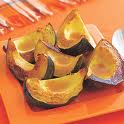
Spicy Baked Squash
Serving Size: 1/4 of an acorn squash
Yield: 4 servings

Ingredients:
vegetable cooking spray
1 acorn squash
dash of salt
2 Tablespoons butter
3 Tablespoons brown sugar
1 teaspoon cinnamon
1/4 teaspoon nutmeg
1/4 teaspoon ginger

Instructions:
  1. Preheat the oven to 400 degrees.
  2. Coat the baking sheet with vegetable cooking spray.
  3. Wash the squash. Cut it in half lengthwise. Remove the seeds. Cut the squash into 1/2 inch slices.
  4. Place the squash on the baking sheet. Sprinkle with salt.
  5. Melt the butter on low heat in a small saucepan.
  6. Add the brown sugar, cinnamon, nutmeg, and ginger to the saucepan.
  7. Spread the butter mix on the squash.
  8. Bake for 20 to 25 minutes, or until tender.
Cost:
Per Recipe: $ 1.42
Per Serving: $ 0.35
Calories 130, fat 6g, Sodium 80mg, sugar 12g, protein 1g

Nutrition Facts
Serving Size: 1 cup, cooked, cubes (205g)
Calories 76 Calories from Fat 6
% Daily Value
Total Fat 1g 1%
Saturated Fat 0g 1%
Trans Fat 0g
Cholesterol 0mg 0%
Sodium 2mg 0%
Total Carbohydrate 18g 6%
Dietary Fiber 6g 23%
Sugars 7g
Protein 2g
Vitamin A 214% Vitamin C 33% Calcium 5% Iron 5%

Tuesday, August 10, 2010

What's Cookin? Tuesday: Crunchy Chicken Salad


What’s in a Name?
Pronunciation: grˉap Spanish name: uva
Grapes are the fruit of the vine in the family Vitaceae and of which there are many different species. The word grape was derived from the Old French term grap, meaning bunch or cluster, and is also the term for a long hook used to harvest these clustered fruits. Vitis labrusca is the most common species, known mainly as table grapes, and can be found in North America. In addition to being used for food products and juice, this species is also used in the production of wine. Other species that are used for winemaking include the wild V. riparia, V. rotundifolia, V. aestivalis (or Norton grape) and V. vinifera, the European winemaking grapes. V. vinifera was also the first Old World species to be planted in California in the late 18th century.

For more information, visit:

Fruity Facts
  • Grapes are actually berries.
  • There is an average of 100 grapes in a bunch.
  • In the United States today, the annual per capita consumption of grapes is about eight pounds, up from 2.5 pounds in 1970.
  • Grapes are about 80 percent water.
  • Concord grapes are one of only three fruits native to North America.


Crunchy Chicken Salad
Serving Size: 3/4 cup Yield: 5 servings

Ingredients:
2 cups chunked cooked chicken
1/2 cup celery
1/4 cup green pepper
1/4 onion
1/2 cucumber
1/2 cup grapes
1 small diced apple (leave the peel on)
1/4 cup yogurt, plain

Instructions:
  1. Use leftover cooked chicken, or cook enough chicken to make 2 cups of chicken pieces.
  2. Chop the celery into small pieces.
  3. Chop the green pepper into small pieces.
  4. Peel and chop 1/4 of an onion.
  5. Peel and chop half of a cucumber.
  6.  Chop the apple into pieces. It’s okay to leave the peel on the apple.
  7. Cut the grapes in half.
  8. Put all the ingredients in a large bowl. Stir together.
Notes: Serve on lettuce, crackers, or bread.

Cost:
Per Recipe: $ 3.46
Per Serving: $ 0.69

Calories 140, fat 4.5g, sodium 65mg, sugar 7g, protein 17g

Tuesday, August 3, 2010

What's Cookin? Tuesday - Great Grape Smoothie

Kristen Mowers, CalSERVES Nutrition Coordinator


Reasons to Eat Grapes
One cup of seedless grapes contains:
  • Antioxidants called flavonoids and phenols that can help prevent heart disease and some cancers.
  • Almost 30 percent of the recommended Daily Value for Vitamin C and also an excellent source of Vitamin K.
  • Fiber, iron, calcium and Vitamin A.
  • About three-fourths cup water, helping to keep the body hydrated.


Great Grape Smoothie
Makes 32 tastes at ¼ cup each

Ingredients:
4 cups seedless grapes
2 cups each frozen cherries and strawberries
2 cups each orange and banana slices
Blender
Paper cups
Combine all ingredients in blender container (divide recipe in half to fit). Blend until mixture is smooth. Pour into cups. Repeat with remaining ingredients.

Tip: For a thicker consistency, freeze grapes before blending ingredients. To freeze grapes, rinse, dry, and spread grapes in a single layer on a cake pan or pie pan. Cover and freeze 11/2 to 2 hours until completely frozen.

Nutrition information per serving:
Calories 187, Carbohydrate 48 g, Dietary Fiber 5 g, Protein 2 g, Total Fat 0 g, Saturated Fat 0 g, Trans Fat 0 g, Cholesterol 0 mg, Sodium 4 mg

Tuesday, June 22, 2010

What's Cookin? Tuesday - Fruit Salad with Jicama

Kristen Mowers, CalSERVES Nutrition Coordinator


A Slice of Melon History
  • Melons were first cultivated in Persia and northern Africa nearly 4,000 years ago, and later by ancient Greeks and Romans.
  • Introduced to western and northern Europe during the Middle Ages, melons were harvested by the Spaniards and later the French and British.
  • Christopher Columbus brought over the first melon seeds to North America on his second expedition, while watermelons arrived with African slaves.
  • In 1683, the melon was introduced to California by Spanish missionaries.
  • Melons and watermelons were grown almost exclusively in home gardens until the first half of the 20th century, when more disease- and wilt-resistant cultivars were developed by the USDA.


Fruit Salad with Jicama
Yield: 7 servings

Ingredients:
1 small jicama
2 cups watermelon cut into pieces
1 mango
1 small papaya
1 lime
2 kiwis
1 teaspoon lime or orange juice
1/4 teaspoon salt
1/4 teaspoon chili powder

Instructions:
1. Wash, peel, and cut the jicama into thin slices.
2. Wash, peel, and cut the rest of the fruit into slices or medium sized pieces.
3. On a large plate, arrange the fruit. Sprinkle the lime or orange juice over the fruit.
4. In a small bowl, mix the salt and chili powder. Sprinkle over the fruit and serve.
5. Refrigerate leftovers within 2 hours.

Calories 80, fat 0g, Sodium 90mg, sugar 12g, protein 1g

Tuesday, June 15, 2010

What's Cookin? Tuesday - Summer Vegetable Spaghetti

Kristen Mowers, CalSERVES Nutrition Coordinator


Veggie Facts
  • Green beans are nitrogen fixers, which means they have the ability to draw nitrogen from the air and return it to the soil. Because of this, farmers often plant beans and legumes in their crop rotations to replenish the soil.
  • Fresh beans are classified into two basic categories: edible pod beans and shell beans. Green beans are the most popular edible pod bean, while Lima beans are the most common shell bean sold in the United States.
  • Compared to dry or shell beans, green beans provide less starch and protein, and more Vitamin A, Vitamin C and calcium.

Summer Vegetable Spaghetti
Serving Size: 1 cup spaghetti and 3/4 cup sauce with vegetables
Yield: 9 servings

Ingredients:
2 cups small, yellow onions, cut into eighths
2 cups chopped, peeled, fresh, ripe tomatoes (about 1 lb)
2 cups thinly sliced yellow and green squash (about 1 lb)
1 1/2 cups cut fresh green beans (about 1/2 lb)
2/3 cup water
2 Tablespoons fresh parsley, minced
1 clove garlic, minced
1/2 teaspoon chili powder
1/4 teaspoon salt
to taste black pepper
1 (6 oz) can tomato paste
1 pound uncooked spaghetti
1/2 cup grated Parmesan cheese

Instructions:
  1. Combine first 10 ingredients in large saucepan. Cook for 10 minutes, then stir in tomato paste. Cover and cook gently, 15 minutes, stirring occasionally until vegetables are tender.
  2. Cook spaghetti in unsalted water according to package directions.
  3. Spoon sauce over drained hot spaghetti and sprinkle Parmesan cheese over top.
Calories 260, Fat 2.5g, Sodium 290mg, Sugar 6g, Protein 11g


Tuesday, June 8, 2010

What's Cookin? Tuesday - Mexican Rice

Kristen Mowers, CalSERVES Nutrition Coordinator


Some Pea History
  • Peas were a dietary winter staple of both peasants and royalty in medieval Europe.
  • In 1492, Christopher Columbus planted peas in Santo Domingo, where they were quickly adopted by indigenous peoples.
  • Easy to grow, peas were commonly planted by early American colonists and later by pioneers traveling west.


Mexican Rice
Serving Size: 1 cup
Yield: 6 servings

Ingredients:
1 cup rice
1 medium chopped yellow onion
1 chopped garlic clove
2 hot water
2 chicken bouillon cubes, low sodium
1 can (8 ounces) tomato sauce
3 1/3 cups frozen vegetables (peas and carrots)
2 Tablespoons chopped fresh cilantro

Instructions:
  1. Lightly spray a large saucepan with nonstick cooking spray.
  2. Add rice to saucepan. Cook over medium heat, stirring occasionally, until lightly browned. Stir in onion and garlic. Cook for 2 to 3 minutes. Add hot water, bouillon cubes and tomato sauce, stirring until bouillon cubes are dissolved. Reduce heat to low. Cover and simmer for 20 minutes.
  3. Add frozen vegetables. Cover and simmer for an additional 10 minutes or until all moisture is absorbed.
  4. Sprinkle cilantro on top of cooked rice. Serve.
Calories 180, Fat 1g, Sugar 3g, Protein 6g

Friday, June 4, 2010

The Best of Summer -Melons!

Kristen Mowers, CalSERVES Nutrition Coordinator


Just the Facts
  • On average, it takes about 10 to 15 bee visits for proper pollination to grow melons.
  • By weight, the watermelon is the most common melon consumed in America, followed by the cantaloupe and honeydew melon.
  • There are many varieties of the “western shipping type” cantaloupe, but since consumers cannot differentiate between them, they are marketed under the general name as “cantaloupe.”
  • There are four main varieties of watermelon: allsweet, ice-box, seedless, and yellow flesh. 


Melon Salsa
Serving Size: 1/4 cup Yield: 12 servings

Ingredients:
2 cups seeded and chopped fresh melon, honeydew, cantaloupe or watermelon, (use one kind or a combination)
1 cup peeled, seeded and chopped cucumber
1/4 cup chopped onion, red or white
2 Tablespoons fresh, chopped cilantro or mint (optional)
1/2 - 1 seeded and finely chopped jalapeño or hot sauce to taste
1/4 cup lime juice or lemon juice
1 Tablespoon sugar, white or brown

Instructions:
  1. In a medium size bowl, stir together all ingredients.
  2. Taste and season with more lemon or lime juice, sugar if needed.
  3. Cover and chill for at least 30 minutes. Serve with grilled or broiled fish or chicken.

Caution: When handling hot peppers, the oils can cause burning and skin irritation. You can wear clean kitchen gloves or wash hands thoroughly after preparing. KEEP HANDS AWAY FROM EYES.

Calories 15, Fat 0g, Sodium 0g, Sugar 3g, Protein 0g

Tuesday, May 18, 2010

What's Cookin? Tuesday - Pea Salad

Kristen Mowers, CalSERVES Nutrition Coordinator
 
  
Just the Facts: Peas
  • The sugar snap pea is actually a hybrid of green and snow peas. It was developed in 1979 to make an edible-pod variety with sweeter, full-sized peas.
  • Edible-pod peas were specifically bred so that the pods' fibers go in one direction, allowing them to be chewed.
  • Today only 5 percent of all peas grown are sold fresh; over half are canned and most of the rest are frozen.
  • One of Thomas Jefferson’s favorite vegetables was the English Pea. He planted more than 30 varieties of it in his garden at Monticello.

Pea Salad with Fresh Herbs

Ingredients:
Makes 10 servings at 1/2 cup each
1/2 lb. sugar snap peas
1/2 lb. snow peas
1/2 lb. fresh green peas, shelled
1/2 bunch mint
1/2 bunch cilantro
1/2 bunch Italian parsley
1 tablespoons light olive oil
2 Tablespoons rice vinegar
Dash salt

Directions:
Wash peas. Remove any stems. Blanch peas in boiling water (blanch pod peas separately from shelled peas). When tender, scoop peas out with strainer and lay out to cool on baking sheet covered with towel. Combine peas in large bowl. Blend herbs, oil, vinegar and salt until smooth. Pour over peas and serve.

Tuesday, April 27, 2010

What's Cookin? Tuesday - Spinach and Mushroom Enchilada Casserole

Kristen Mowers, CalSERVES Nutrition Coordinator


California is the leading producer of fresh market and processed spinach in the United States.

Spinach was the first frozen vegetable to be sold for commercial use.

Spinach began being cultivated in North America by the early 19th century. In recent times, it has been popularized by the cartoon character, Popeye, who attributes his amazing strength to a daily diet of the green, leafy vegetable. In fact, when Popeye made his debut on January 17, 1929, spinach became the third most popular children’s food after turkey and ice cream. Today, more than 94 percent of Americans associate spinach with Popeye.

Green fruits and vegetables help maintain vision health and strong bones and teeth. They may also lower the risk of some cancers. Examples include spinach, cabbage, celery, leeks, peas, collards, avocados, kiwis, honeydew melon and green grapes.


Spinach and Mushroom Enchilada Casserole
Yield: 8 servings

Ingredients:
2 teaspoons olive oil
1 medium chopped onion
2 minced garlic clove
3 seeded, deveined and minced yellow banana chile peppers
3 pounds sliced mushrooms
1 can (14 ounce) enchilada sauce (preferably green)
8 - 6 inch corn tortillas - cut in half
1/4 teaspoon salt
1/2 teaspoon dried oregano leaves
2 packages (10 ounce) frozen chopped spinach, - thawed
6 1/2 ounces grated reduced fat Monterey jack cheese

Instructions:
  1. Heat oil in a very large non-stick skillet. Add onion, garlic and peppers and stir. Add mushrooms and cook about 15 to 20 minutes, until liquid evaporates. (If pan is not large enough, cook mushrooms in batches.)
  2. Pour half of the enchilada sauce into a 13x9-inch baking dish.
  3. Arrange 8 tortilla halves over the sauce in the baking dish. Preheat the oven to 350 degrees. When mushrooms are cooked, stir in the salt and crumble in the oregano leaves. Drain the spinach, squeeze it dry and mix it thoroughly with the mushroom mixture. Spoon half the mushroom mixture into the baking dish, carefully covering tortillas.
  4. Set aside 1/4 cup (about 1 ounce) of grated cheese. Sprinkle the rest of the cheese on top of the mushroom mixture. Layer with the remaining 8 tortilla halves, then the remaining mushroom mixture and enchilada sauce. Sprinkle top of casserole with the remaining 1/4 cup cheese. Cover baking dish with foil and bake for 30 minutes, or until casserole is steaming hot in the center.
Note: Allow casserole to stand at room temperature 5 minutes before serving. Serve with pinto or black beans and salad. 

Calories 240, Fat 11g, Sodium 350mg, Sugar 5g, Protein 16g

Tuesday, April 20, 2010

What's Cookin? Tuesday - Quick and Creamy Grape Shake

Kristen Mowers, CalSERVES Nutrition Coordinator


A Bunch of Grape History
Grapes are one of the oldest cultivated fruits. Hieroglyphics show that Egyptians were involved in grape and wine production, and the early Romans were known to have
developed many varieties.

Grapes have been grown in California for more than 200 years. The tradition of viticulture began in 1769 when Spanish friars established missions throughout the region. Padres planted a European grape variety known as the Mission in order to make sacramental wine. Native American wild grapes of the type Vitis girdiana grew along California stream banks, but these grapes were sour and of little use for winemaking.

In California, the boom in grapes planted for fresh consumption arose in the early 1800s when a number of settlers recognized the untapped agricultural possibilities of
the then-Mexican territory. William Wolfskill, a former trapper (and also founder of California’s citrus industry) planted the first table grape vineyard in 1839 on pueblo land near present-day Los Angeles.

By the 1850s, the United States had officially acquired California from Mexico and 80,000 gold prospectors had moved to the region, a few of them recognizing that there
was money in grapes as well as ore. The young agricultural society recognized that grapes were an important commodity in which to invest, and today California wine, table grapes and raisins are all important agricultural commodities, with approximately 700,000 acres planted in vineyards.


Enjoy this little taste of history!

Quick and Creamy Grape Shake
Makes 4 servings (1 cup per serving)

Ingredients:
2 cups green or red seedless grapes
2 bananas, peeled and sliced
2 oranges, peeled and quartered
12-16 ice cubes, crushed

Preparation:
Place grapes, bananas, oranges, and ice in a blender container.
Blend until smooth. Pour into glasses and serve.

Calories 139, Carbohydrate 36g, Fiber 4g, Protein 2g, Fat 0g, Cholesterol 0mg, Sodium 2mg

Tuesday, March 30, 2010

What's Cookin? Tuesday - Craving Carrots?

Kristen Mowers, CalSERVES Nutrition Coordinator


Carrots are rich in beta carotene — more than 400 percent of the recommended Daily Value (DV) — a form of Vitamin A when absorbed by the body. Beta carotene is important for eyesight, skin and normal growth. It may also help reduce chronic diseases such as cancer and heart disease.

Baby-cut carrots are made from full-grown, small diameter carrots by peeling and cutting them to the desired length. They are planted closer together so the roots stay slim and there is less waste when the carrots are cut to their small size. True baby carrots are removed from the ground early and actually look like miniature carrots.

Carrots are biennial, meaning they have a two-year life cycle. In the first year, the edible root is formed, followed by production of the flower and seeds in the second year.

Even Cookie Monster would agree these are better then chocolate chip!


Carrot Cookies
Serving Size: 2 cookies
Yield: 30 servings

Ingredients:
1/2 cup soft margarine
1 cup honey*
1 cup grated raw carrots
2 well beaten egg whites
2 cups all purpose flour
2 teaspoons baking powder
1/4 teaspoon baking soda
1/4 teaspoon salt
1 teaspoon cinnamon
2 cups raw oatmeal, quick cooking
1 cup raisins

Instructions:
  1. In a large bowl, cream together margarine and honey. Stir in carrots and egg whites.
  2. Stir together flour, baking powder, baking soda, salt, cinnamon, oatmeal and raisins. Gradually stir flour-oatmeal mixture into creamed mixture, just until all flour is mixed. Do not over mix.
  3. Drop from teaspoon on greased baking sheet. Flatten slightly and bake at 350 degrees for 10 minutes, or until lightly browned.
*Note: Instead of honey, you can use 1 1/4 cups sugar mixed with 1/4 cup water.

Cost:
Per Recipe: $ 3.54
Per Serving: $ 0.12

Recipe from www.recipefinder.nal.usda.gov

LinkWithin

Related Posts Plugin for WordPress, Blogger...